How Much Exercise Does a Aussiedoodle Need? Plus Brain Games
General training information. Every dog is an individual; for health or behavior concerns, see your veterinarian.
The Aussiedoodle is an Australian Shepherd and Poodle cross. Many owners are surprised by how much it asks of them. A quick walk around the block rarely covers it.
This guide shows you how to build a daily plan that mixes physical exercise with real mental work. It also covers the mistakes that tend to cause trouble. Every dog is different, so treat the numbers here as a starting point, not a rule.
What the published sources say about Aussiedoodle exercise
There is no official breed standard for this cross. The AKC does not list the Aussiedoodle as a breed, according to Canine Bible, so there is no AKC exercise rating to quote. The figures below come from pet-information websites, and they do not agree with each other.
| Source | What it says |
|---|---|
| Canine Bible | Adults need at least 60 to 90 minutes of daily exercise plus mental stimulation. |
| Hundeo | Rates exercise needs as high and says about 2 hours of active exercise a day. |
| Oodlelife | Suggests 30 to 90 minutes of walks plus play. |
So how much exercise does an Aussiedoodle need? The honest answer is a wide range, from about 30 minutes at the low end to around 2 hours at the high end. Size and the generation of the cross both vary. Canine Bible lists heights of 14 to 23 inches and weights of 25 to 70 pounds, depending on the Poodle size used.
A small, calm dog from one litter and a leggy, driven dog from another may need very different amounts. Your own dog will tell you more than any chart.
Why this cross needs more than a walk
Canine Bible describes the Aussiedoodle as a companion dog that combines Australian Shepherd herding drive and athleticism with Poodle intelligence. Hundeo rates the cross as very trainable. That mix is a lot of brain and a lot of energy in one dog.
Oodlelife warns that without enough mental stimulation, these dogs can get bored and destructive. Canine Bible also lists separation anxiety and barking as challenges. A dog with unused energy and an unused mind may show it in ways you notice fast.
Aussiedoodle mental stimulation matters as much as the miles. A tired body with a bored mind often still wants something to do.
What you need
- A well-fitted harness or flat collar and a standard leash, plus a longer line for sniff walks in safe, legal areas
- Small, soft treats that you can break into tiny pieces
- A puzzle feeder or snuffle mat, or a muffin tin and a few tennis balls
- A few cardboard boxes, towels or old cups for hiding games
- A water bottle and a collapsible bowl for outings
- A timer or phone, so you can keep sessions short
- A notebook to track what your dog does after different days
You do not need to buy anything special. Household items work for most of the games below.
Step 1: Start with your dog's age and health
Check with your veterinarian before you set an exercise target. This matters most for puppies, seniors and any dog with a health concern.
The sources we relied on do not give a firm puppy exercise limit for this cross. Do not guess at one. Ask your vet how much running, jumping and stair work is right for your puppy's age and growth stage.
Hip dysplasia is described by Oodlelife as the biggest health concern for the cross. Hundeo also lists eye problems and skin or coat problems. Your vet can tell you whether your dog needs any limits. Never judge pain or lameness yourself.
Step 2: Pick a daily baseline
For a healthy adult, a reasonable starting point is the middle of the published ranges. Think in terms of 60 to 90 minutes of active time a day, split across the day, as Canine Bible suggests. Then adjust.
- Try the baseline for a full week.
- Notice how your dog behaves in the evening. A settled dog that naps and chews a toy is a good sign.
- If your dog paces, nips at ankles or invents chaos, add more activity or more brain work.
- If your dog limps, lags or seems sore the next day, cut back and call your vet.
Hundeo says a dog may need about 2 hours of active exercise. Some Aussiedoodles may truly need that. Build up to it slowly instead of jumping straight in.
Step 3: Split the day into sessions
Two or three outings usually work better than one long one. A sample day for a healthy adult might look like this:
- Morning: a 30 to 45 minute walk with plenty of sniffing
- Midday: a 10 minute training game or puzzle feeder
- Afternoon or evening: 20 to 30 minutes of play, such as fetch in a fenced area
- Before bed: a calm nose-work game or a few tricks
Add up your own total and compare it with the ranges above. On rainy days, swap some outdoor time for indoor games.
Step 4: Turn walks into sniff walks
Sniffing is mental work. A slow walk where your dog gets to read the ground can tire a dog out more than a brisk one.
- Pick a route with grass, trees or varied smells, in a place where dogs are allowed.
- Use a longer line where it is safe and legal, and stay aware of your surroundings.
- Let your dog choose the pace for part of the walk. Pause when they stop to sniff.
- Use a cue like "let's go" to end a sniff and start moving again. Reward when your dog turns to you.
- Mix in a few short training moments, such as sit, wait or a recall, then go back to sniffing.
Check local leash rules before you go. Rules differ by city, county and park, and your local animal control or parks office can tell you what applies.
Step 5: Add brain games
Canine Bible says the Aussiedoodle does well in agility, trick training, therapy work and advanced obedience. Those activities share one thing. They give the dog a job and a puzzle to solve. You can copy that at home in a few minutes a day.
Puzzle feeders and food hunts
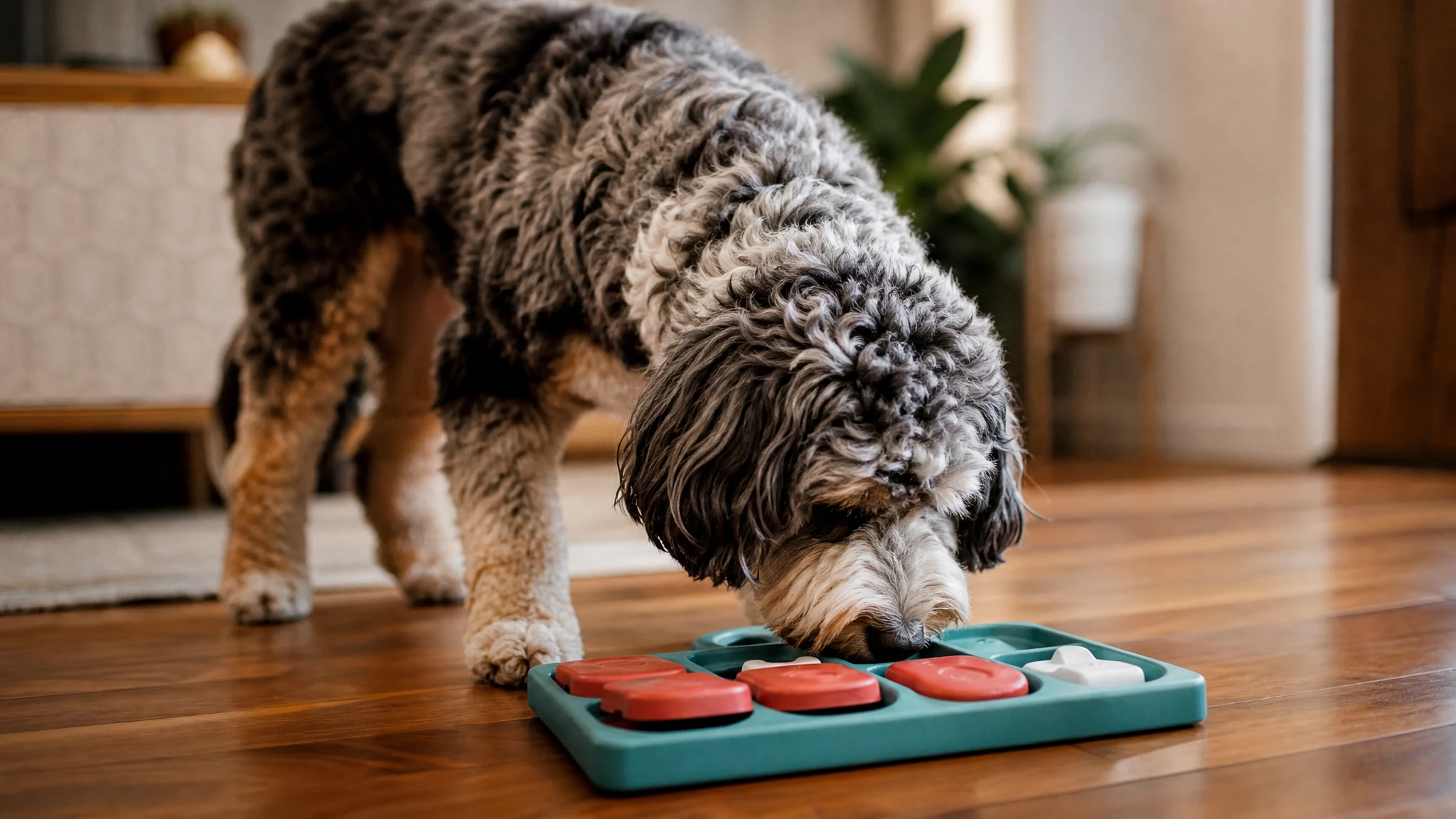
Put part of a meal into a puzzle feeder or snuffle mat instead of a bowl. Or scatter dry food across a towel and roll it up loosely. Your dog has to unroll it and find the pieces.
Ask your vet how to count treats and puzzle food toward the daily total. Oodlelife notes that the cross can be prone to obesity, so measure what goes in.
Find it
- Show your dog a treat, then place it under one of three cups.
- Say "find it" and let your dog nose or paw the right cup.
- Reward at once.
- Next, hide treats around one room while your dog waits, then release them to search.
- Later, hide treats in boxes, behind chair legs or on low shelves.
Trick training
Tricks are a good fit for a smart, eager dog. Try spin, paw, bow, roll over, or putting toys in a basket. Break each trick into tiny steps and reward each small piece. Canine Bible and Oodlelife both say positive reinforcement works best for this sensitive cross.
Herding-style games
The Australian Shepherd side of the cross may show up as a drive to herd. Canine Bible says Aussiedoodles may try to herd children or other pets. Oodlelife adds that this can lead to scratches or bites.
Give that instinct a safe outlet. Roll a large exercise ball across a fenced yard and let your dog push it. Or practice "go to your mat" and "wait" around moving objects. Keep young children and small pets out of these games, and stay close to supervise.
Short obedience refreshers
Ten minutes of recall, loose-leash walking and stay work counts as mental exercise. For a full step-by-step plan, see our guide on how to train an Aussiedoodle. Oodlelife and Canine Bible both suggest starting obedience as soon as the dog comes home.
Step 6: Vary the work so your dog does not get bored
Canine Bible notes that these dogs bore easily, so vary sessions. Rotate games across the week.
- Monday: sniff walk and puzzle feeder
- Tuesday: fetch and a new trick
- Wednesday: hike or swim if your dog enjoys it and the area is safe
- Thursday: nose work and obedience refreshers
- Friday: play with a friendly dog you know well
- Weekend: a longer outing and a new place to explore
Canine Bible lists hiking and swimming among the activities that suit the cross. Not every dog loves water, so let yours decide. Never force a swim.
Step 7: Plan for rest and calm
More is not always better. A dog that is always wound up can learn to expect constant action. Build in downtime.
- Teach a settle on a mat. Reward calm lying down in small steps.
- Offer a chew or lick mat after play, so your dog learns that winding down has a reward too.
- Keep a quiet crate or bed spot available.
Rest also helps with separation anxiety, which Canine Bible lists as a challenge for the cross. A dog that has had exercise, a brain game and a calm settle is better prepared to be alone. If anxiety is serious, talk to your vet or a qualified, reward-based trainer.
Common mistakes to avoid
- Only walking. A long walk covers the body but may leave the mind idle.
- Too much, too soon. Build up gradually, especially for puppies and out-of-shape adults. Your vet can set the limits.
- Skipping hard surfaces and heat checks. Hot pavement and summer afternoons are tough on dogs. Walk early or late in the day.
- Feeding extra treats without adjusting meals. Obesity is a listed concern, and training treats add up.
- Ignoring the herding instinct. Chasing, nipping at heels and rounding up children are signs to redirect, not punish.
- Using harsh methods. Reward-based training is the approach backed by the American Veterinary Society of Animal Behavior. Shock, prong or choke collars, and dominance methods can damage trust and make behavior worse.
- Forgetting the coat. Canine Bible notes that wavy or curly coats mat easily. After outdoor play, check for burrs and tangles.
Tips for making it stick
- Keep sessions short. Five to ten minutes of focused work often beats a long, tired one.
- End on a win. Finish each game with something your dog can do easily.
- Use part of the regular meal as training reward.
- Note what works. Your notebook will show which games calm your dog and which wind them up.
- Talk to your vet before starting intense activity such as long runs or lots of jumping.
What results to expect
Many owners find that a steady mix of exercise and mental work may help a dog settle more easily at home. A dog that gets enough of both may be less likely to chew furniture, bark for attention or hunt for trouble. Results vary by dog, age, health and how consistent you are.
Give any new routine a few weeks before you judge it. If problem behaviors continue or get worse, talk with your vet to rule out health causes. Then consider a qualified trainer who uses reward-based methods.
The published ranges for Aussiedoodle exercise are wide because the cross itself varies. Start in the middle, watch your dog, and adjust. Pair the physical work with brain games, and you give this bright, busy dog what it was bred to enjoy: a job to do alongside you.