Crate Training a Aussiedoodle and Preventing Separation Anxiety
General training information. Every dog is an individual; for health or behavior concerns, see your veterinarian.
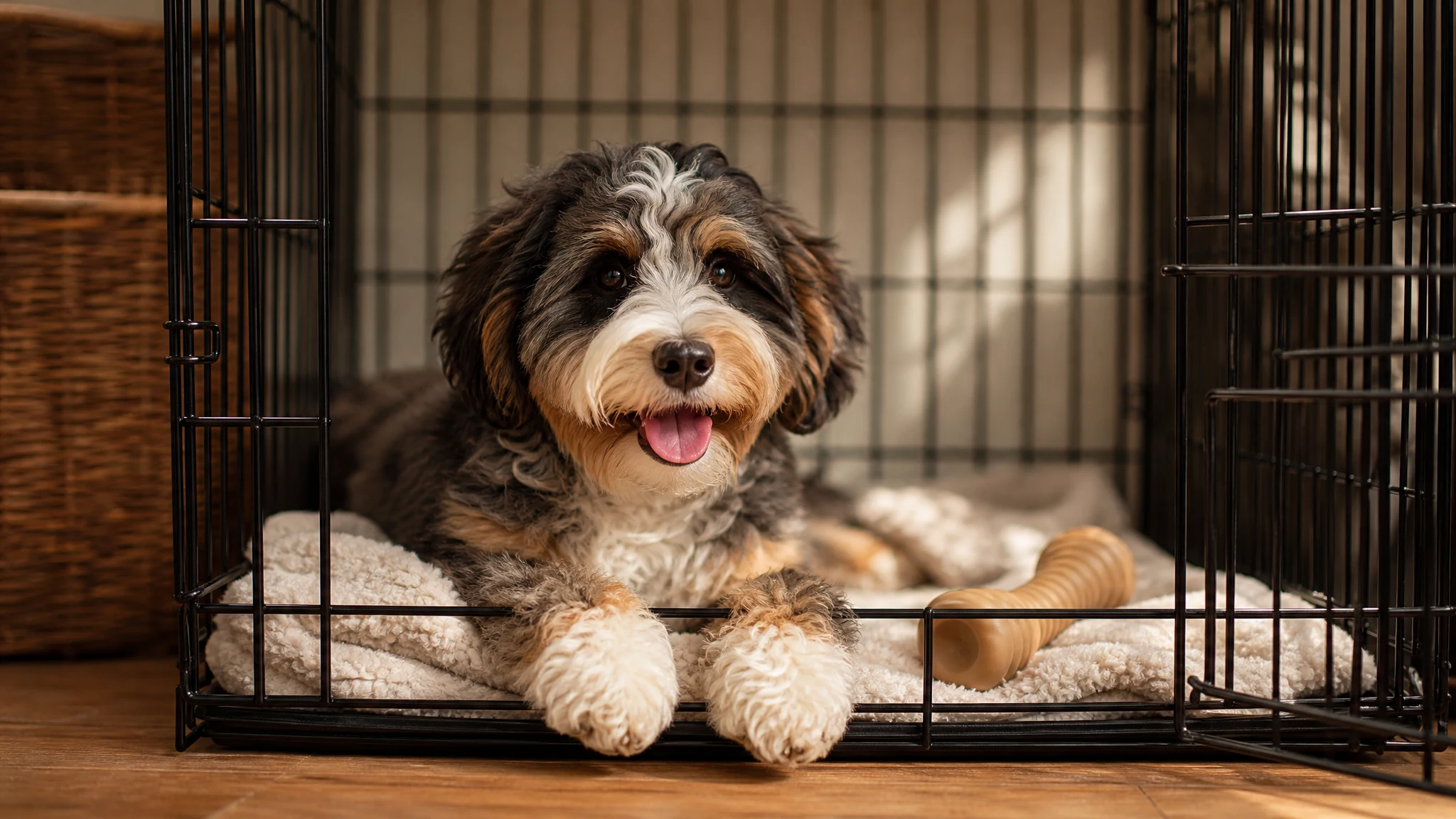
Aussiedoodle crate training is one of the best gifts you can give a dog that loves company. A crate gives your dog a quiet den, a safe place while you are busy, and a routine that makes being alone less scary.
Separation anxiety is a real concern with this cross. Canine Bible, a pet-information site, lists it among the breed's known challenges. The good news is that a slow, reward-based plan helps many dogs feel calmer when they are left. This guide walks you through it.
Why this breed needs a thoughtful plan
The Aussiedoodle is a cross of the Australian Shepherd and the Poodle. It is a hybrid, so the American Kennel Club does not list it as a recognized breed, and there is no breed standard to measure against. Canine Bible describes the temperament as cheerful, affectionate, social and people-oriented.
People-oriented dogs can struggle when the people leave. Canine Bible and Oodlelife also point to boredom and destructiveness when these dogs lack mental stimulation. A crate alone will not fix that. A crate paired with enough exercise, enrichment and gradual practice can help.
Every dog is an individual. Some Aussiedoodles settle into a crate in days. Others need weeks of patient work.
Materials you will need
- A crate sized for your dog. See the sizing section below.
- A crate divider panel if you are starting with a puppy, so you can grow the space with the dog.
- A washable mat or blanket. Skip anything your dog tries to chew apart.
- Small, soft treats your dog loves, cut into tiny pieces.
- Safe chew items and a food puzzle or stuffable toy. Ask your veterinarian which chews suit your dog.
- A cover or crate sheet for a den feel, if your dog likes it.
- A timer or phone to track short practice sessions.
- A baby gate or exercise pen for the stage when you step out of the room.
Choosing the right crate size for an Aussiedoodle
Aussiedoodle sizes vary a lot. Canine Bible lists a height range of about 14 to 23 inches and a weight range of about 25 to 70 pounds. It notes that size depends on the Poodle size used in the cross. These figures come from a pet-information site, not a breed standard, so treat them as a rough guide.
That range is wide, so measure your own dog instead of guessing. The general rule for any dog is that the crate should be tall enough to stand without ducking, long enough to turn around, and roomy enough to lie stretched out. Too much space can make it easier for a puppy to use one end as a toilet.
- Weigh your dog and note the current height at the shoulder.
- Check the crate maker's own sizing chart. Brands label sizes differently, so confirm with the brand rather than assuming.
- For a puppy, buy a crate that fits the expected adult size and use a divider to shrink it for now. Ask your breeder or veterinarian what adult size to plan for, since littermates and generations of the cross can differ.
- Choose a sturdy model with a secure latch. A bored, clever dog may test weak doors.
Step-by-step: how to crate train your Aussiedoodle
Reward-based training is the approach recommended by the American Veterinary Society of Animal Behavior (AVSAB). Canine Bible also notes that positive reinforcement works best for this sensitive dog. Never push, drag or force your dog into the crate, and never use the crate as punishment.
Step 1: Set up a calm spot
Place the crate in a room where the family spends time, such as the living room. Put the mat inside and leave the door propped open so it cannot swing shut and startle your dog.
Step 2: Make the crate a good place
Toss a few treats near the door, then just inside, then toward the back. Let your dog walk in, eat and walk out freely. Praise quietly. Do this for several short sessions across the day.
Feed some meals inside the crate. Start with the bowl near the door and move it back a little at a time as your dog gets comfortable.
Step 3: Add a cue
When your dog steps in on their own, say a simple cue such as "crate" or "bed" and reward right away. Keep your voice cheerful and the pace relaxed.
Step 4: Close the door for a moment
Once your dog goes in happily, close the door for two or three seconds while they eat a treat, then open it. Build up in small steps: five seconds, ten, thirty, a minute. If your dog whines or paws, you went too fast. Go back to an easier step and try again.
Step 5: Stay nearby, then move around
With the door closed, sit beside the crate and read or scroll your phone. Then stand, walk a few steps, and return. Reward calm behavior with a treat through the door. Keep sessions short and end them while your dog is still relaxed.
Step 6: Add a long-lasting chew
Give a stuffable toy or safe chew only in the crate. Canine Bible and Oodlelife both note that this breed bores easily, so rotate a few different items and vary the sessions. A job to do makes the crate more interesting.
Step 7: Practice at night
Many owners keep the crate in the bedroom at first. Hearing you nearby can help a young dog settle. A puppy will need potty breaks, so ask your veterinarian how long your puppy can reasonably wait at their age. Take them out calmly, without play, and return them to the crate.
Building alone time without panic
Crate training and alone-time training are related but not identical. A dog can love the crate and still panic when you leave. Teach both skills in small steps.
- Short exits. Leave the room for a few seconds with your dog crated and a chew in place. Return before any fuss starts.
- Longer exits. Stretch to a minute, then five, then ten. Mix easy and slightly harder trials so the pattern is not predictable.
- Leave the house. Step outside for a short time, then come back. Keep both departures and returns quiet and low key.
- Add real-life tasks. Pick up your keys, put on your shoes, and then sit back down. This takes the drama out of your leaving cues.
- Lengthen slowly. Only go longer when your dog is calm at the current length. If you see signs of stress, drop back to an easier level.
Before you leave for longer periods, give your dog a chance to burn energy. Sources differ on how much exercise adults need. Canine Bible suggests at least 60 to 90 minutes of daily exercise plus mental stimulation, Hundeo says about 2 hours of active exercise, and Oodlelife suggests 30 to 90 minutes of walks plus play. Your dog's age, health and energy will decide what is right, so ask your veterinarian.
Include sniffing walks, training games and puzzle feeders. A tired, mentally satisfied dog usually finds it easier to rest.
Signs of separation distress
Watch for patterns that show up mainly when you are gone or about to go. A camera or phone can help you see what happens while you are out.
- Barking, howling or whining that goes on and does not settle
- Pacing, panting or drooling in the crate or the room
- Trying to escape the crate, including bent bars, scraped paws or damaged doors
- Chewing doors, frames or furniture near exits
- Toileting indoors when you are gone, in a dog who is otherwise reliable
- Refusing food or treats when alone
- Following you from room to room and showing worry as you get ready to leave
Not every sign means anxiety. Boredom, too little exercise, a medical problem or a puppy who is still learning can look similar. That is why an honest check of the whole picture matters.
When to see a veterinarian
Call your veterinarian if your dog shows intense distress, hurts themselves trying to escape, stops eating, or has toileting accidents that are new or out of character. Pain and other health problems can change behavior, and only a veterinarian can sort that out.
If distress continues despite careful, gradual practice, ask your veterinarian about the next step. They may refer you to a qualified behavior professional who uses reward-based methods. Do not give any medication or supplement unless your veterinarian prescribes it.
One breed-specific note: Wikipedia describes the Australian Shepherd as one of the more commonly affected breeds for the MDR1 mutation, which causes drug sensitivity. Because the Aussiedoodle has an Australian Shepherd parent, mention this to your veterinarian before any medication is discussed.
Common mistakes to avoid
- Using the crate as punishment. It teaches your dog to fear the place you want them to love.
- Going too fast. Long stretches too early can build fear instead of comfort.
- Making departures emotional. Big goodbyes and excited greetings can raise your dog's arousal.
- Skipping exercise and mental work. A bored dog may chew and bark, which is easy to mistake for a crate problem.
- Letting the dog out during crying. Wait for a brief pause, then open the door, so your dog does not learn that noise opens it. If your dog is truly panicking, though, stop and go back a step instead of pushing through.
- Leaving a collar or loose items that could snag. Check the crate for anything unsafe.
- Relying on the crate for long hours. A crate is a tool, not a place to spend most of the day. Plan breaks, walks or help for long workdays.
- Ignoring coat care. Canine Bible notes that wavy or curly coats mat easily, and matted fur is uncomfortable in a small space. Brush regularly.
Tips for keeping the crate positive
- Rotate the special crate-only chew so it stays exciting.
- Keep sessions short and upbeat, since this breed is described as very trainable but easily bored.
- Start obedience early. Canine Bible advises beginning as soon as the dog comes home.
- Keep a steady daily routine for meals, walks and rest.
- Watch your dog's weight. Oodlelife says the cross is prone to obesity, so count crate treats as part of the day's food.
- Make coming home calm. Wait until your dog is relaxed before saying hello.
What results to expect
With steady practice, many dogs learn to treat the crate as a comfortable resting place. Your dog may begin walking in on their own, settling faster and showing fewer signs of stress when you leave. Progress is rarely a straight line, and a move, a schedule change or an illness can set things back for a while.
Timelines vary by age, history and personality. Some dogs are comfortable within a couple of weeks, while others need much longer. No method comes with guarantees, and some dogs need extra help from a veterinarian or behavior professional. Keep the pace slow, celebrate small wins, and adjust the plan to your dog.