Leash Training a Aussiedoodle: Pulling, Lunging and Loose-Leash Walking
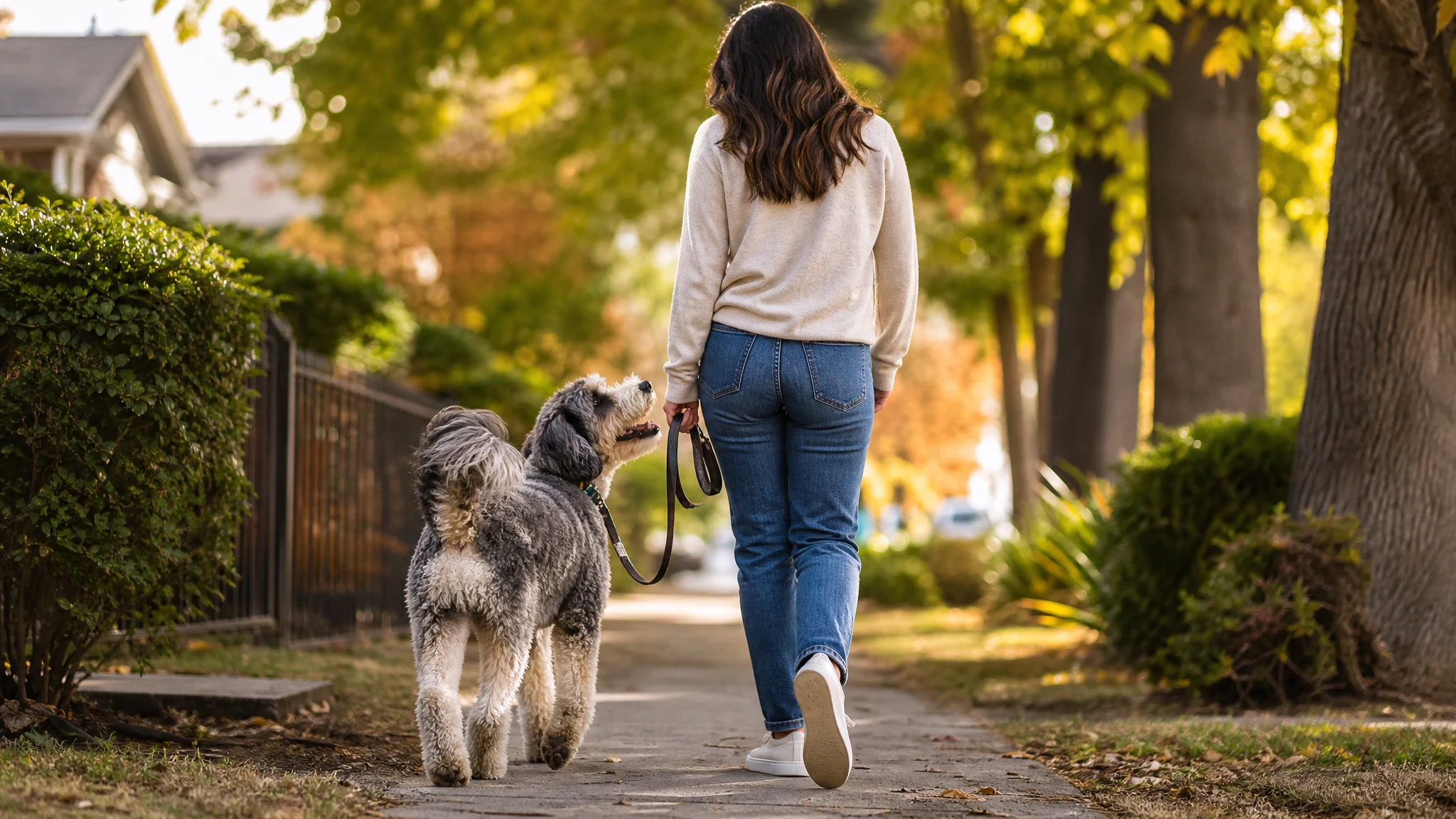
General training information. Every dog is an individual; for health or behavior concerns, see your veterinarian.
Most Aussiedoodle owners hit the same wall around the second week of walks. The dog is sweet at home, then the leash clips on and you are being towed down the street by a cheerful, curly rocket.
This guide covers how to leash train a Aussiedoodle using reward-based methods. You will get the gear list, a step-by-step plan, loose-leash games, and a plan for lunging at triggers. Every dog is different, so treat the timelines as rough guides and not promises.
Why Aussiedoodles Pull on the Leash
Aussiedoodle pulling on leash is rarely stubbornness. It usually comes down to how the breed is built and what a normal walk offers.
- Energy. Hundeo rates the Aussiedoodle's exercise needs as high and says about 2 hours of active exercise a day. Canine Bible says adults need at least 60 to 90 minutes a day plus mental stimulation, and Oodlelife says 30 to 90 minutes of walks plus play. The sources disagree, so watch your own dog. A dog who has not burned off energy will pull harder.
- Herding background. The Aussiedoodle is an Australian Shepherd and Poodle cross. Canine Bible describes it as combining Australian Shepherd herding drive and athleticism with Poodle intelligence. Oodlelife notes these dogs may try to herd children or other pets. On a walk, that can show up as fixating on or chasing moving things.
- People focus. Canine Bible describes the breed as cheerful, affectionate, social and people-oriented. A dog who loves everyone wants to say hello to everyone, and that means surging toward passersby.
- Boredom. Oodlelife warns about boredom and destructiveness without mental stimulation. A predictable stroll around the same block may not give a clever dog enough to think about.
- Reward history. Every time a pull gets the dog closer to a smell, a person or a squirrel, the pull gets paid. This is true for every breed.
Individual dogs vary. Some Aussiedoodles are calm walkers and some are not. Judge your dog, not the label.
Materials You Need
- A flat collar with an ID tag, fitted so you can slip two fingers under it.
- A front-clip harness with a ring at the chest. When the dog pulls, it turns the dog gently sideways instead of letting them lean forward into it.
- A standard 4 to 6 foot leash. Skip retractable leashes while training. They teach the dog that tension means keep going.
- Small, soft treats that the dog loves, cut pea-sized. Oodlelife lists obesity as a tendency for the breed, so count training treats as part of the daily food and keep them tiny. Ask your veterinarian how much is right for your dog.
- A treat pouch so rewards come fast.
- A clicker or a marker word such as Yes, if you like.
What not to buy: prong, choke and shock collars. They work by causing discomfort, and they are not in line with the reward-based approach recommended by the American Veterinary Society of Animal Behavior (AVSAB). They can also make a reactive dog worse by linking pain with the thing they were looking at.
One coat note. Canine Bible says wavy or curly coats mat easily. Check under the harness straps and behind the front legs after walks, and brush those spots, because rubbing can tangle the coat.
Step-by-Step: How to Leash Train a Aussiedoodle
Step 1: Get comfortable with the gear indoors
Put the harness on, give a treat, and take it off. Repeat a few times over several days. Then clip on the leash and let the dog drag it around the house while you hand out treats. Keep sessions to a few minutes.
Canine Bible suggests starting obedience as soon as the dog comes home, so there is no reason to wait for a certain age to begin these basics.
Step 2: Teach the dog that your side pays
In a hallway or quiet room, hold treats at your hip. Each time the dog is next to you, mark with Yes and give a treat at your leg. Take one step, mark and treat. Build up to a few steps, then a lap around the room.
You are paying for position. Pick a side and stay with it so the dog learns where the good stuff happens.
Step 3: Add the leash in a low-distraction place
Move to a driveway, backyard or quiet corner. Walk a few steps with the leash loose in a J shape, marking and rewarding whenever the leash hangs slack and the dog is near you. Reward more often than feels necessary. Early on, aim for a treat every few steps.
Sensitive dogs tend to do better with calm, upbeat sessions. Canine Bible says positive reinforcement works best for this sensitive dog, so keep your voice cheerful and your corrections out of it.
Step 4: Stop when the leash goes tight
This is the classic and most useful rule. If the leash goes tight, stop moving. Stand still like a tree and stay quiet. Do not yank back.
The moment the dog looks back at you or steps back so the leash slackens, mark and reward, then walk on. The dog learns that tension stops the walk and slack keeps it going. If the dog will not come back, take a step or two backward and reward when the dog follows.
Step 5: Raise the difficulty slowly
Practice on the sidewalk in front of your house, then around the block, then somewhere busier. When the dog starts to fail, you went too fast. Go back to an easier spot for a few sessions.
Vary the sessions. Canine Bible and Oodlelife both note these dogs bore easily, so change direction, speed up and slow down, and use different routes.
Step 6: Use real-life rewards
Once the dog walks nicely most of the time, treats can become less frequent. Start rewarding with things the dog wants: a sniff of a good spot, a greeting with a friendly person who asks first, or permission to move toward a favorite tree. A loose leash earns the thing the dog was pulling toward.
Loose-Leash Games for a Busy Brain
These games give an energetic, clever dog something to do besides pull.
- Treat scatter. Toss a few treats on the ground and let the dog sniff them out while on leash. It slows the walk and burns mental energy.
- Pivot game. Walk, then turn and head the other way with a happy voice. Reward when the dog catches up and the leash is loose. The dog learns to keep an eye on you.
- Check-in game. Reward every time the dog glances at you without being asked. Over time, looking at you becomes a habit.
- Stop and sit. Every so often, halt. Reward if the dog sits or stands by you without being told.
- Speed changes. Walk slowly, then jog a few steps, then slow again. Reward the dog for matching you with a loose leash.
- Trick breaks. Canine Bible lists trick training among the activities suited to the breed. Ask for a spin or a hand target mid-walk, then reward.
Fixing Lunging at Triggers
Lunging is different from ordinary pulling. The dog is reacting to something specific, such as another dog, a bike, a skateboard, a jogger or a child running. Because Oodlelife notes the breed may herd children or other pets, a dog that fixates on fast movers may be showing that instinct. A dog that lunges at other dogs could be excited, frustrated or worried, and those need different handling.
- Find the distance. Work out how far away the trigger can be before your dog stops being able to listen. That is the starting distance, and it may be quite far.
- Mark and reward the first look. When the dog notices the trigger and looks at it calmly, say Yes and feed several treats in a row. The trigger showing up should predict good things.
- Turn and leave early. If the dog stiffens, stares or starts to pull, do a calm U-turn and walk away before the lunge happens. Reward when the leash goes loose.
- Use space. Cross the street, step behind a parked car or use a driveway. Putting room between you and the trigger is a skill, not a failure.
- Shrink the gap slowly. Over many sessions, work a little closer only when the dog stays relaxed.
Do not punish the lunge. Scolding, leash jerks and pain-based tools tend to add stress to an already worked-up dog. If lunging is intense, includes growling or snapping, or involves a bite risk, contact a qualified reward-based trainer or a veterinary behaviorist for hands-on help. Ask any trainer how they work before you book, and avoid anyone who recommends shock, prong or choke collars.
Tips for Better Walks
- Exercise first. A short game of fetch or a play session before the walk can take the edge off. Save training for when the dog can think.
- Keep sessions short. Five to ten focused minutes beat a long frustrating outing.
- Practice at calm times. Do not try to train loose-leash walking when you are late for work.
- Be consistent. Everyone who walks the dog should use the same rules. If one person allows pulling, it will be harder to fade it for everyone else.
- Pair training walks with sniff walks. A longer, relaxed walk where the dog may sniff on a loose leash meets the dog's needs without turning every outing into a drill.
- Plan for the separation side. Canine Bible lists separation anxiety as a challenge for the breed. If your dog is frantic when you leave and pulls hard toward home, mention it to your veterinarian.
Common Mistakes to Avoid
- Moving while the leash is tight. Every step forward on a tight leash rewards the pull.
- Yanking the leash. It can hurt the dog's neck and teaches nothing about what to do instead.
- Going to busy places too soon. A dog who cannot walk loosely in the driveway will not do it at the park.
- Stingy rewards. Early on, pay often. You can thin it out later.
- Skipping mental exercise. If the dog is under-stimulated, even perfect technique will be hard to keep up.
- Ending on a bad note. Finish each session with an easy win.
- Using pain-based gear. Prong, choke and shock collars are not part of reward-based training.
What Results to Expect
Many owners see small improvements within a couple of weeks of daily practice, such as more check-ins and shorter pulling bursts. Reliable loose-leash walking in distracting places often takes longer, and it can come and go during adolescence. Results depend on the dog, the environment and how consistent the household is, so progress may look different for you.
Expect setbacks. A new neighborhood, a day with less exercise or a high-excitement trigger can bring old habits back. Go back to the easier step and rebuild.
If your dog suddenly starts pulling or lunging when they did not before, or seems sore, stiff or unwell on walks, talk to your veterinarian. Pain and other health problems can change behavior, and only a vet can sort that out.
Size matters for planning too. Canine Bible lists adults at roughly 25 to 70 pounds, depending on the Poodle size used in the cross, and Hundeo gives a similar spread. A dog at the top of that range can pull with real force, so build the skill early while the dog is still small enough to manage easily.